Le geste manquant
Silence
Silence.
Hessie breaks her silence.
As if seized by the urgency of an imminent end, Hessie unfurls her train of thought and memories after decades spent cultivating mystery and anonymity.
Silence.
Hessie offers us the gift of her words.
Silence is the title that the artist Perrine Lacroix chose to give to her filmed portrait of Hessie, shot in the spring of 2016. The fruit of their close friendship, this intimate and poetic portrait reveals the artist at home, at the Hérouval Mill, as if swathed in the greenery of her garden. The sound of the wind in the dancing tree leaves and the surrounding birdsong seem to create a lull around Hessie’s words. Designed as a diptych, Perrine Lacroix’s film combines Hessie’s words and world into a single vision — the shot and countershot of her universe: a still framing of the artist and, to its right, moving footage of the inside of the mill’s living quarters and garden, which Hessie and her husband, the painter Dado, converted into an art studio in the late 1960s. The camera moves about this living and creative space in which their five children grew up and where writers, art critics, collectors and artists like Mythia Kolesar rubbed shoulders. In fact, it was seeing Kolesar’s film Transe-perce Survie (1974) that prompted Lacroix to create a follow-up to this experimental portrait. The Slovakian artist and filmmaker’s 1974 short film showed Hessie in her garden, surrounded by her children, wearing a turban and a mask, armed with threads and needles, weaving her own clothes or making a chicken wire pen for her dwarf hens… Mythia and Perrine’s films converse with one another with great beauty, friendship and generosity. In both films, the mill’s setting provides a poetic and enchanting backdrop, giving further insight into Hessie’s woven works.
Silence.
Hessie explains that she “mulled things over” for a long time before settling on fabric and yarn. Inspiration struck her when she came across a white sock darned by a monk at an exhibition at the Museum of Decorative Arts in Paris.
“Seeing that sock, which a monk had mended and resewn on his own… I was so fascinated (…) by the fact that such an ordinary thing could become so enormous.”
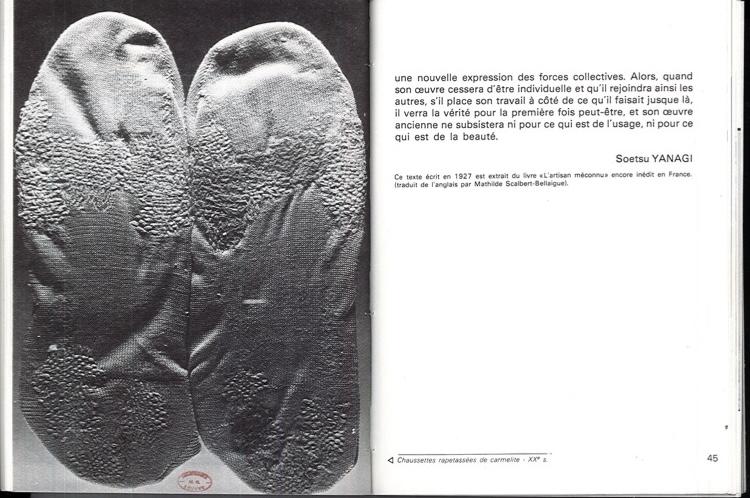
I looked for that sock for a long time, to no avail. It was only when I stopped searching that it finally appeared. As I was browsing the catalogue of the exhibition Artiste/Artisan? in the spring of 2024, a pair of darned socks cropped up.
Silence.
I was seized with a combined sense of emotion and fascination.
These socks were most definitely extraordinary.
Extraordinarily humble and precious.
These socks were mended and resewn so many times, not by a monk, as it turns out, but by a Carmelite, who devoted her entire life to manual labour, prayer and… silence.
Silence.
Apparition.
I see silence.
Is it even possible to see silence?
And yet, it is silence that seems to emanate from these socks and the stitches all over them. These “cobbled up” socks illustrate a text by Japanese art critic Sōetsu Yanagi, titled The Unknown Craftsman. According to this master of mingei — a Japanese folk art movement —, the beauty of craftsmanship stems from usage and intimacy. This beauty found in usage, intimacy and silence fascinates and moves me, as if these socks were revealing the secrets of the original action to me. The missing action.
Silence.
Stitch
Sewing stitch. Suture stitch. Tyre stitch.
Mending, darning, cobbling up, patching up, sewing.
To repair, connect, tie together, unite.
United for life.4
Puncture patches are at the heart of Perrine Lacroix’s latest project, which she worked on during a residency programme at the Rustin factory. The artist took an interest in the history of the Rustine patch — a rubber disc that could be stuck like a band-aid to a punctured inner tube — that Louis Rustin patented in 1922. A humble little disc, but a revolutionary one. Armed with her camera, the artist walked around the factory, discovering the age-old machines, observing the choreography of gestures that have been performed, taught, and transformed throughout the centuries. She photographed work gloves cast aside at the end of the day as if they were sculptures shaped by the imprint of a precise gesture, inhabited by the memory of a body. Depending on the machines, the workers’ actions sculpt different shapes, and so these protective gloves tell the stories of skills and techniques. As I look at the series Gants [Gloves, 2025], I am reminded of philosopher Gilbert Simondon’s words: “what resides in machines is human reality, human actions fixed and crystallised in functioning structures”.5 It is as if Perrine Lacroix had revealed a missing action to us: from the craftsman’s action to the mechanical action; from hand to machine. In Jacquard (2025), a waterjet-cut red rubber suspension, the artist traces the coded patterns of a Jacquard card, from the name of the inventor of the first programmable mechanical loom in 1801. A Jacquard card6 or punched card is a piece of thin but rigid cardboard whose surface is coded with a pattern that can be read by a device capable of detecting the presence or absence of a hole. In Jacquard (2025), the code becomes the central motif of the piece, highlighting the missing action of the translation: from line to code to stitch. The punched cards made by workwomen translate the patterns into code in order to guide the loom’s hooks, which in turn raise the warp threads, and in the process revolutionised the fields of textile production as well as computer science. In fact, punched cards were precursors to mass storage cards used in early computing. Incidentally, the word “patch” is also used to describe a temporary fix to a software resource. From sewing to computer coding to puncture patch, there truly is only a stitch.
Silence.
Stitch.
Code.
Armour
I think back on the little socks that the Carmelite darned, using stitches that form a repetitive, obsessive grid. Shifting between the conceptual and the sensual, the visual and the tactile, the grid is one of the emblematic motifs of the 20th century, explored by the likes of Piet Mondrian, Franck Stella, Agnès Martin, Annie Albers, as well as… Hessie.
Silence
In French weaving terminology, the woven grid, or weave, is called “armour”. This original technique dates back to the Neolithic Age, where it was used to make fabric, baskets, and objects for everyday use, protection and survival. According to German architect and art critic Gottfried Semper (1803-1879), this “armour” could be considered the origin of all artforms. This criss-crossing of vertical warp and horizontal weft would not only give birth to all other artforms but also to more advanced technologies. In this sense, weaving is both ancestral and futuristic.8 In her recent installation and performance pieces, artist and researcher Cécile Babiole explores the multiple intertwined links between weaving and arithmetic, and between textile and technology. Working with both visuals and sound, this pioneering artist in the fields of electronic and digital arts has taken a deep interest in weaving. Playing on the medium’s algorithmic possibilities, she highlights the codes of textile techniques, which she then repurposes to create sound weavings, such as Loops of the Loom (2024). The piece’s premise is to give the weaving a voice, to sound the code that is interlaced in the “armour”: a mythical, ancestral, original grid. Instead of using typical textile yarns (cotton, wool…), the artist creates “armours” with electric wires, more specifically audio cables, through which she transmits the sound of the woven motifs.
Silence.
The weaving speaks.
“I like to imagine the invisible flux of electrons innervating the woven pieces and breathing life into them, so to speak.”
Loop, in this case, is to be understood in its computing sense, as a programming loop. The “armour” as a warp-and-weft motif, under and over, vertically and horizontally, outlining a code that Cécile Babiole interprets as if it were sheet music for rhythmic sequences. And so, using the three basic “armours” that are the plain weave, twill and satin, as well as their variantions, the artist converts the visual motif of the grid into an acoustic motif. The rhythmic sequences are made from samples of the artist’s voice: mouth sounds, onomatopoeia, whispers… In Sergé pressé, the soundtrack describes the weaving algorithm thread by thread: colour of the yarn, under, over… Entirely handwoven, the series Loops of the Loom (2024) displays the technicity of weaving, asserting it as a form of programming. In doing so, Cécile Babiole playfully subverts the stereotypes that have long marginalised textile arts as a women’s craft.
And therefore domestic.
And therefore not learned.
And yet weaving is both medium and symbol, motif and code, material and algorithm. Cécile Babiole upsets this imagination by making the links between computing archaeology and weaving history visible and audible. This history is told in Radio TXT (2024), in which a radio set is worked into a weaving, the warp of which is made out of copper wires. These wires serve as the radio’s antenna, which broadcasts short thematical segments about textile in the form of news flashes. Once again, it is the artist’s voice we hear, telling us about the relationship between textile and language; textile and text; textile and computing. In fact, the artist says that she was particularly inspired by hand-woven ferrite magnetic-core memory planes, made out of small ferrite rings with wire passing through them to read or write information. These toroid magnetic memory cells were used as random-access memory for computers from 1955 to 1975. For example, the on-board computer for the Apollo 11 mission, which went to the moon in 1969, included a hand-woven core memory unit for data and programme storage.
Silence.
Stitch.
Moon.
I think back on the little socks that the Carmelite darned in contemplation and silence.
Silence
Hessie was right.
These socks are most definitely extraordinary.
Silence.
I have found the missing action.
It went to the Moon.
Notes :
1 Artiste/Artisan ? exposition présentée au Musée des Arts Décoratifs du 23 mai au 5 septembre 1977
2 Une religieuse de l’ordre du Carmel.
3 Sōetsu Yanagi (1889-1931) est un penseur, critique d’art et collectionneur japonais, grand défenseur de l’art populaire, en particulier coréen.
4 Slogan de la Rustine depuis 1922 et titre de l’édition qui accompagne la restitution de résidence de Perrine Lacroix dans les établissements Rustin, dans la Sarthe, grâce au dispositif Résidence d’artiste en entreprise.
5 Gilbert Simondon, Du mode d'existence des objets techniques, 1958, Paris, éd. Aubier, p. 12
6 Joseph-Marie Jacquard met au point avec le menuisier Jean-Antoine Breton, le métier à tisser Jacquard, premier système mécanique programmable à cartes perforées.
7 Kuo Michelle, “Textility and Technology”, in Woven Histories: Textiles and Modern Abstraction, p. 238
Texte produit par le Réseau documents d’artistes, 2026.


Production : Les Abattoirs, Musée - Frac Occitanie Toulouse
Voir le film


Résidence portée par Les Moulins de Paillard, soutenue par le ministère de la Culture - Drac des Pays de la Loire

Ensemble de pièces tissées sonores dont la grille du tissage est interprétée comme une partition musicale.
Cadres en bois, câbles audio, lecteurs audio, amplificateurs, haut-parleurs
Vues de l'exposition personnelle Loops of the Loom, Musée des Tapisseries, Aix-en-Provence, 2024 - Photos © Luce Moreau
Écouter les pièces sonores