Marianne Plo
The trouble is, we’ve all let ourselves become part of the killer story, and so we may get finished along with it. Hence it is with a certain feeling of urgency that I seek the nature, subject, words of the other story, the untold one, the life story.
Ursula K. Le Guin, The Carrier Bag Theory of Fiction, 1986.
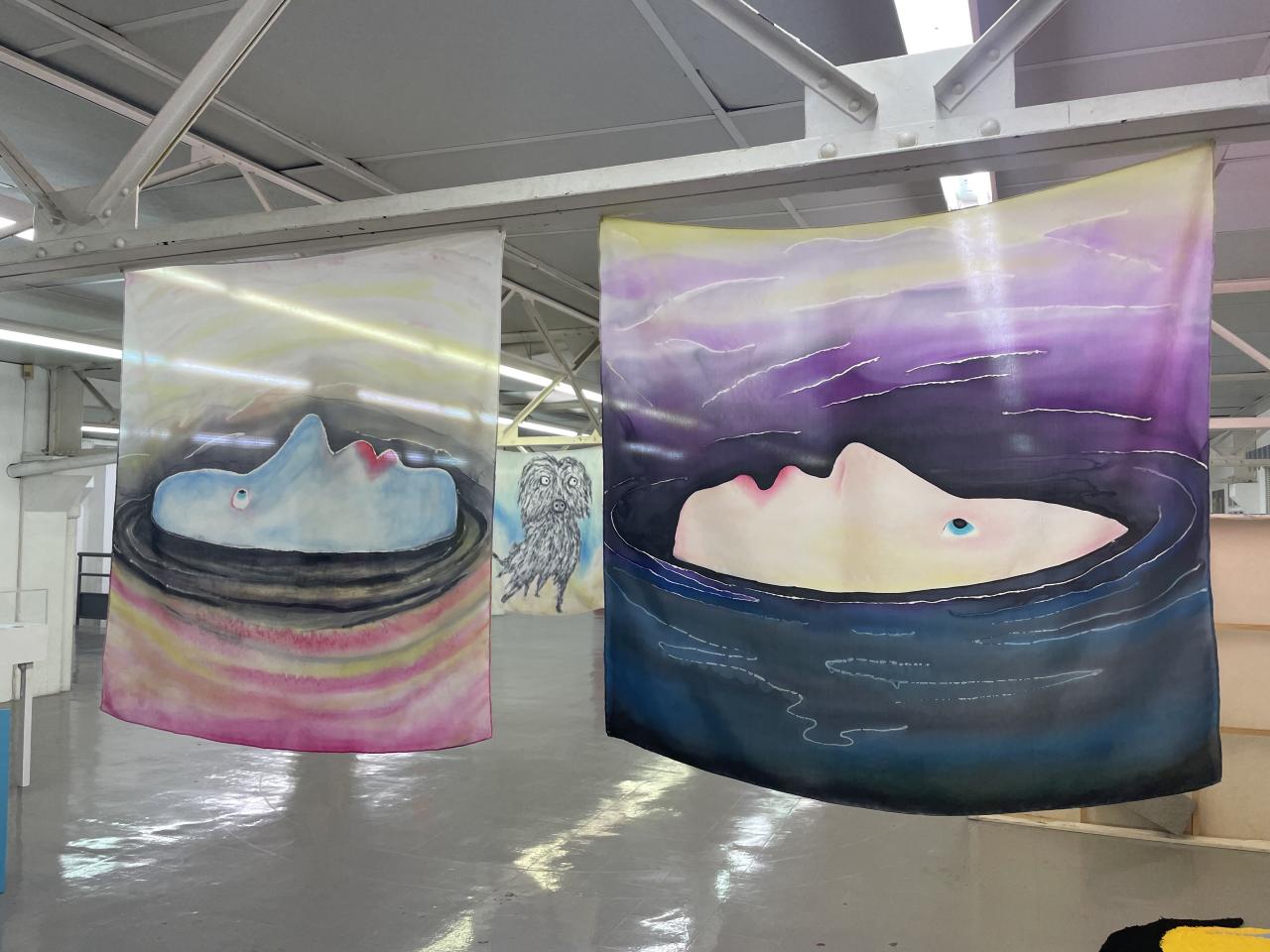
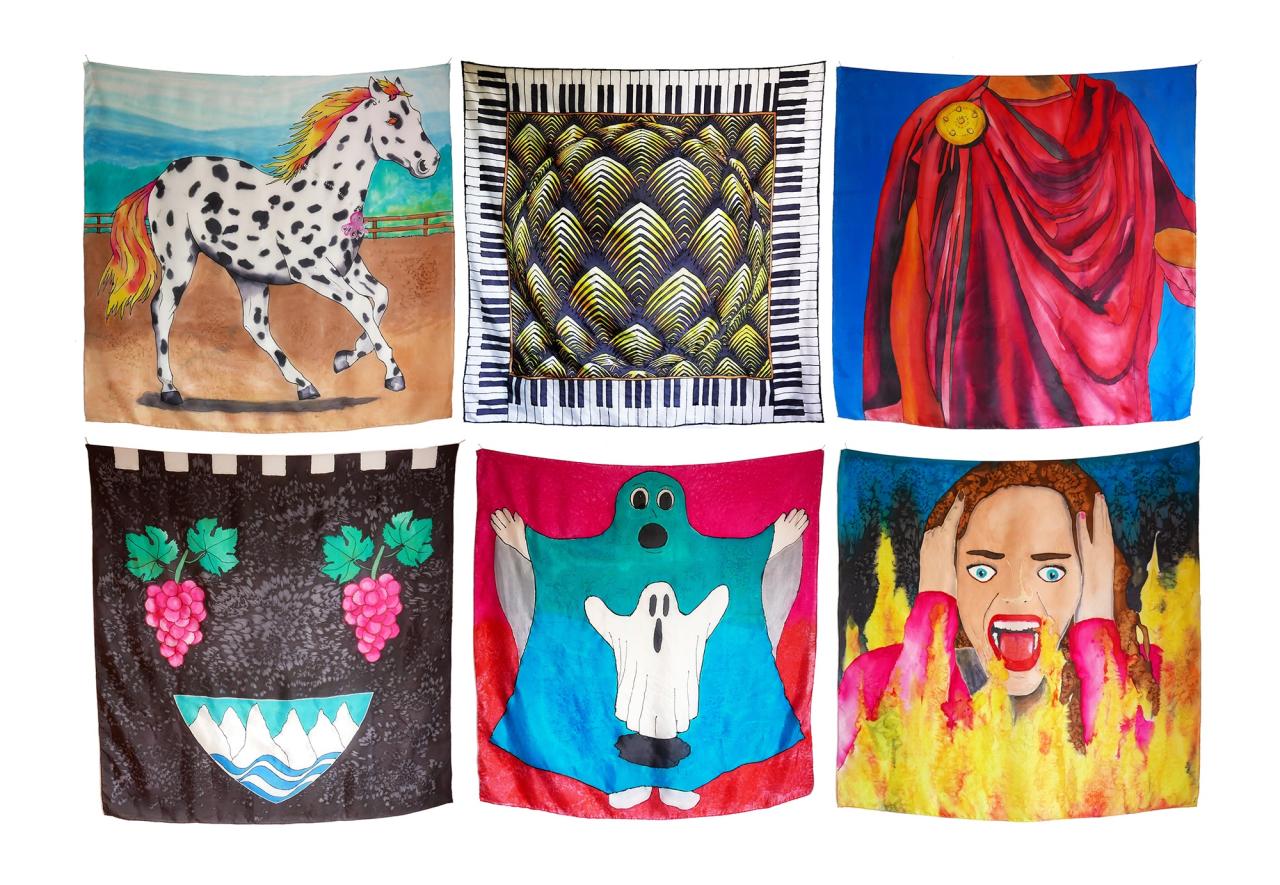
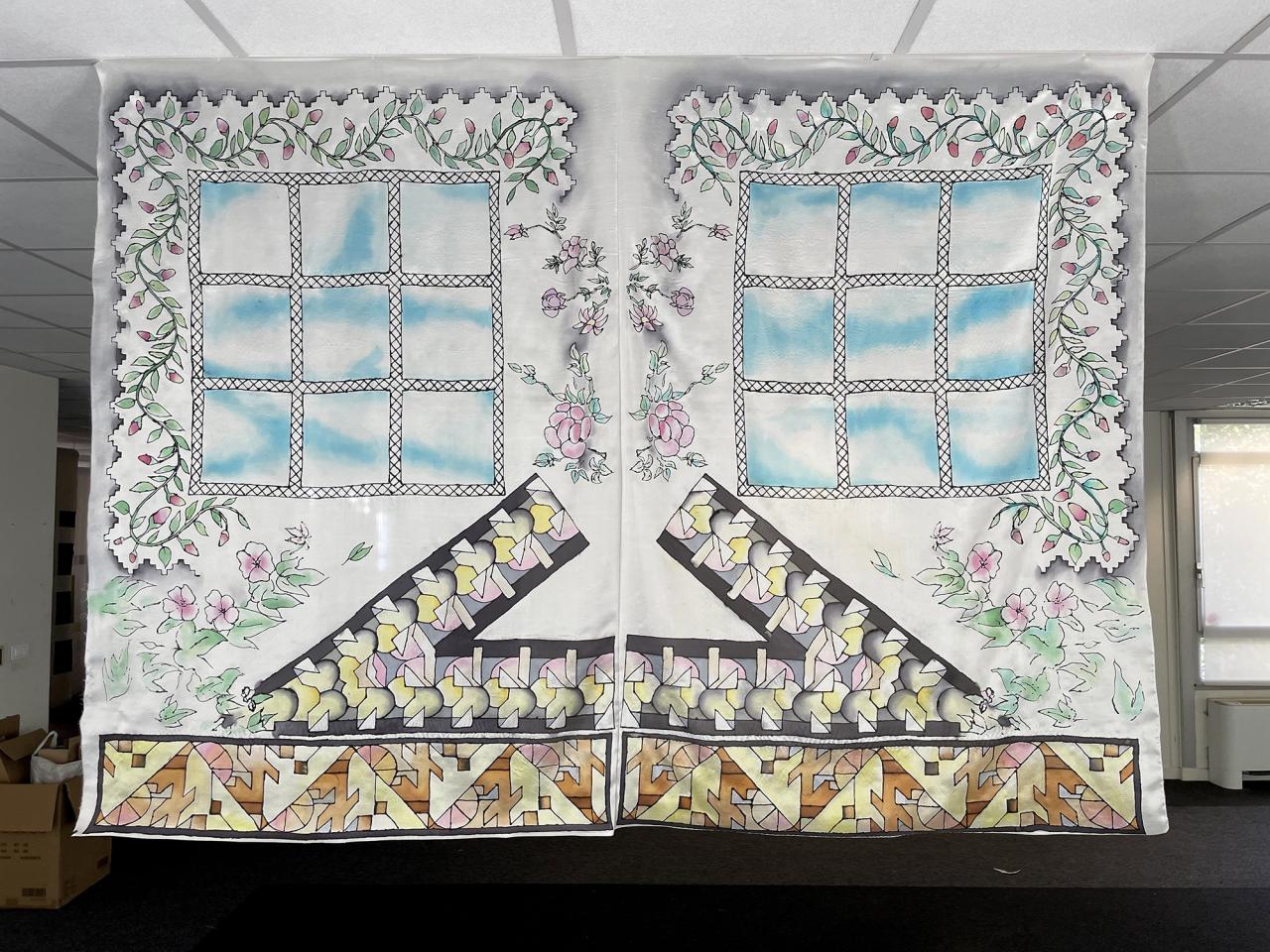
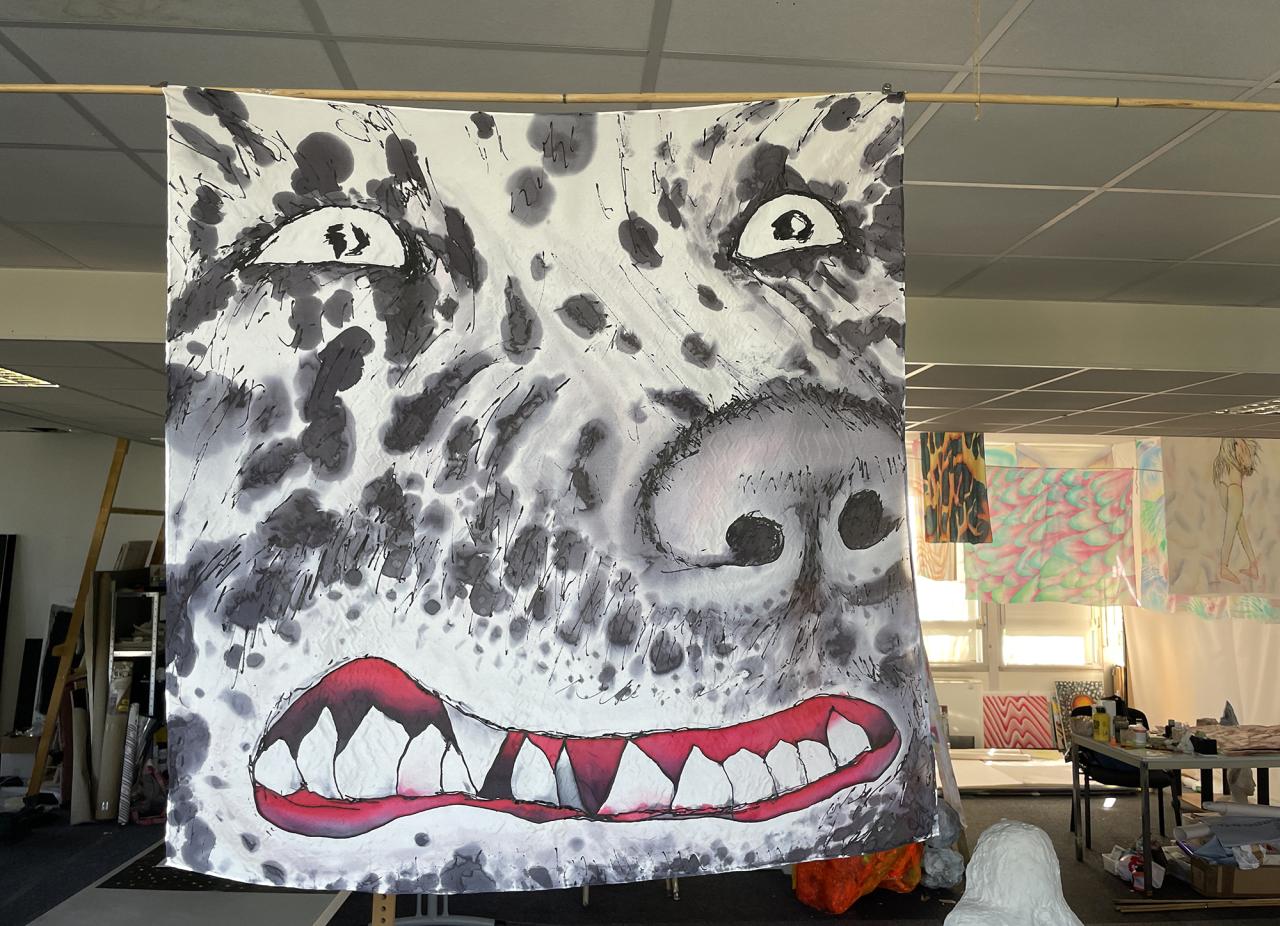
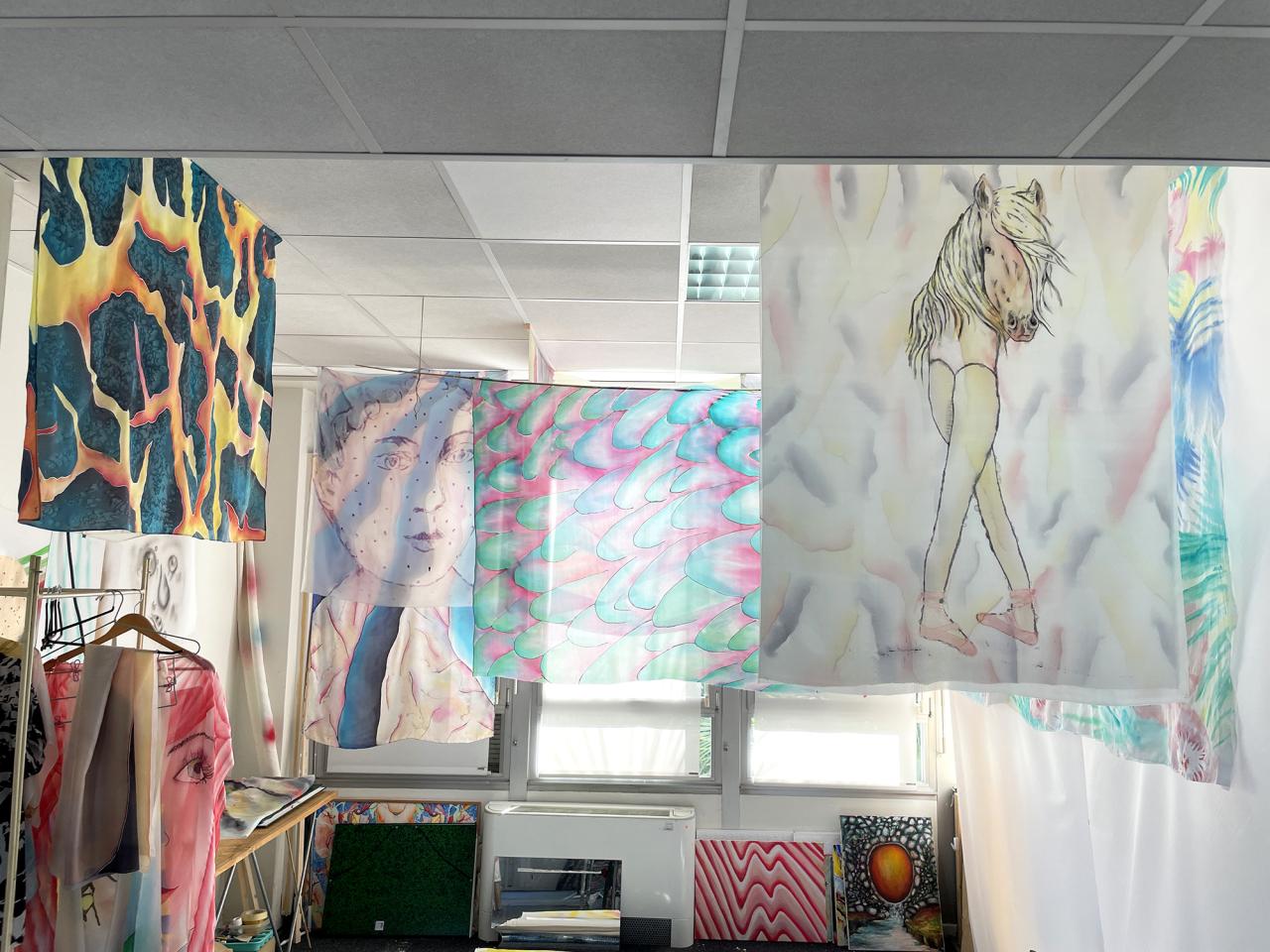
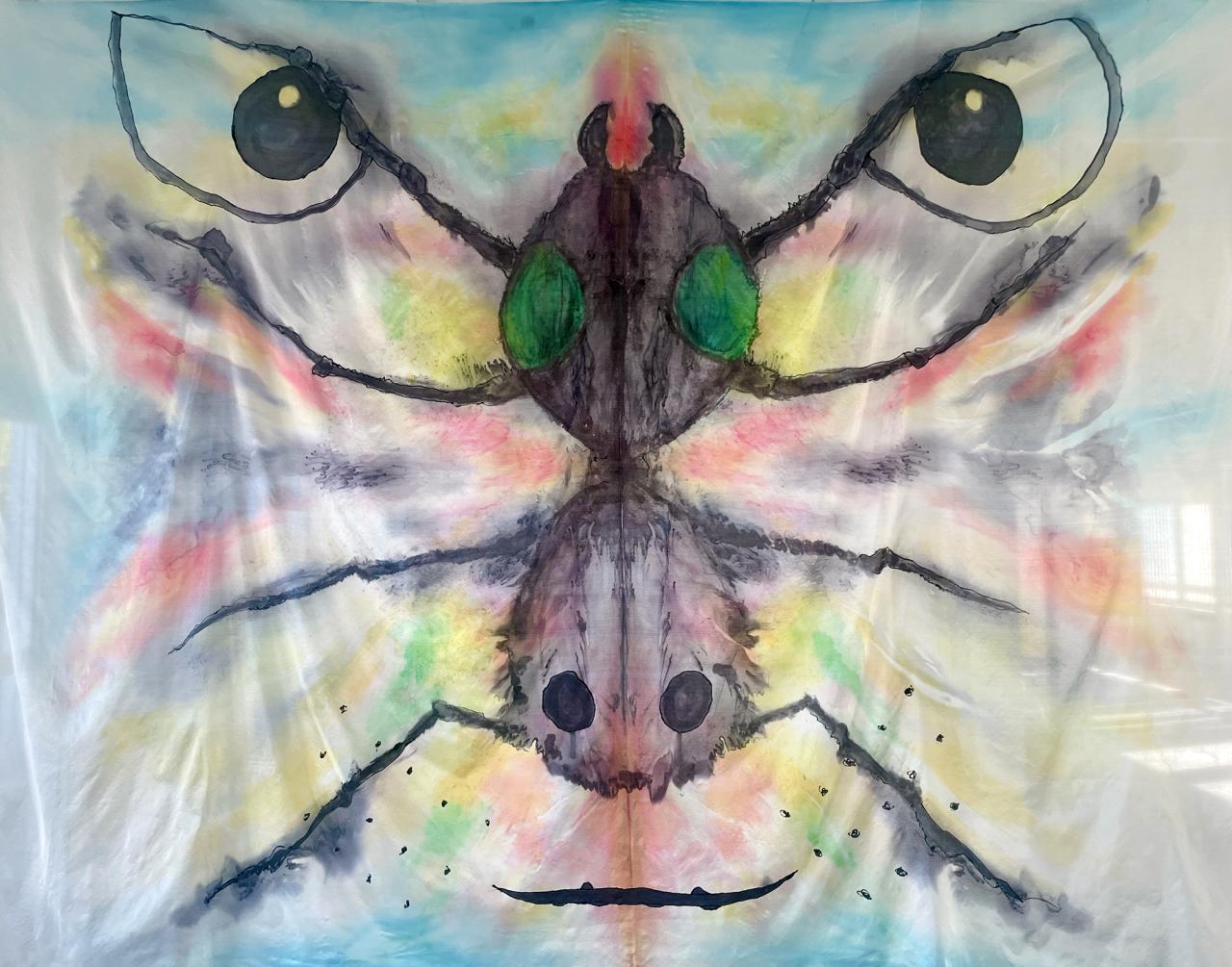
In the beginning there is a need, an urgency and an irrepressible pleasure to paint and draw. Marianne Plo samples, collects, and makes images. She scours the Internet, magazines and books for triggers: colours, light, patterns, subjects, composition, graphic design. A gleaned image becomes a stimulant, a reason to paint, to react to an emotion, an intuition or an urge. Marianne Plo’s paintings on silk and paper should be understood as a language in and of itself. An open score in which each work ricochets off another. The artist does not conceive of them as autonomous entities, but rather as a collective. Hanging in the exhibition space, they form landscapes designed as layered planes with various depths and viewpoints. These floating images act as screens that react to the variations in light, airflow and bodies moving among them. The visual dialogue between the works, which are meant to clash with one another, produces a poem in which images stand in for words. Marianne Plo excludes any form of restriction of her visual thought process in favour of “poetic freedom”. The conversation between the pieces produces coded sentences in which echoes, beginnings of stories and projections can take shape. The artist also speaks of a “heterogeneous jumble” in which all sorts of things can be found: a mountain, a cluster of cheetahs, a close-up of a green-eyed woman, the Little Mermaid, piano keys, flaming meteorites, a wistful cat, an accordion, a ghost, an ant-spider or a bus on fire. The combination of these works acts as a rebus which contains a message or messages that only Marianne Plo is able to decipher. She adds: “I like to paint lots of different themes so that I can talk about the world (on my own scale), showcase its variety, its diversity and all of its nuances, so I can attempt to understand what binds them all together. To weave a link from the Part and the Whole and from the Whole to the Part.”1 The artist nurtures a fierce sense of mystery, secrets that bleed into the folds of the silk. Because she refuses to be boxed into any specific theme, concept or “artistic jargon” that she does not identify with, Marianne Plo practices the art of the escapade. With no particular drive to demonstrate, she deconstructs hierarchies between genres, styles, pictorial formulation and subjects. This well-kept mystery is perhaps that of a vortex-like self-portrait through which the artist reveals the thread of her thoughts, desires, feelings and qualms.
Speaking of the many ways in which one might envision the narrative, American science fiction author Ursula K. Le Guin wrote the following in 1980: “to compose a narrative is to use language to connect events in time. This connection, whether envisioned as a closed sequence (“beginning-middle-ending”) or an open one (“past-present-future”), either linear or in a spiral (or recursive), involves a movement “through” time for which spatial metaphor is an adequate description. Narrative makes a journey.”2 Marianne Plo’s creative process is like an intuitive spiral that produces parallel and/or intertwined narratives, which materialise through colour and depiction. The artist speaks of “chain reactions”, working with associations, shifts and rebounds. Ursula K. Le Guin’s words come to mind again: “The organism is an arrangement in space and time, an iterative structure, a process; the mind is the product of the body, an organ. And it does what other organs do: it organises. Organise, structure, connect. What could be better to logically combine perceptions as supremely disparate as the vague memory of a crocodile, a deceased great-aunt, the smell of coffee, a cry from Iran, a bumpy landing and a hotel room in Cincinnati… Yes, what could be better than narration? A wonderfully flexible technique, or a survival strategy, which, if wielded astutely and cleverly, will give each of us with the most riveting saga of all: ‘The story of one’s life.’”3
The choice of silk painting is no coincidence. Marianne Plo includes the technique in the category of “modest arts”.4 In the West, this particular practice is associated with arts and crafts, and is also assigned to an assumed feminine realm. The artist learnt its various techniques at a “grandmas’ club”. Since then, she has kept experimenting with it, with a particular fondness for its awkward linework, its lack of precision, its mishaps and accidents. She asserts herself as a colourist, moving freely between styles, registers, periods and genres. From portraiture to (not quite) still life, she paints landscapes, animals and patterns that she repeats in an almost psychedelic way. In doing so, she invites us to immerse ourselves in a stream of flowing and moving images, the scales and planes of which range from microcosm to macrocosm. From the mountain to the inside of a rock to an ancient goddess (real or imaginary), from a fire to diffracted light, the artist wanders through a layered world which embraces memory, imagination, intimate experience, time, space, and culture. In this sense, her pictures are the product of a maelstrom of thoughts: a powerful existentialist whirlwind. They manifest wide and narrow perceptions of human experience, in all of its facets, realities and fantasies. From childhood to adulthood, the artist Plo delves deep into ancestral fears, disasters, silenced concerns, and moments of wonder, solitude, rage, tenderness, ingenuity, pleasure and escapism. From wall paintings to smartphones, Marianne Plo’s pictorial language formulates, on the surface of a physical medium, the sensory and secret narrative of a human epic.
Notes:
1 All quotes by Marianne Plo are taken from various in-person or written conversations with the artist, which took place between the months of August and November 2024.
2 LE GUIN, Ursula K. “Quelques réflexions sur la narration”, in Danser au bord du monde – mots, femmes, territoires. Paris: Editions de l’Eclat, 2020, p. 56.
3 LE GUIN, Ursula K. (2020), p. 60-61.
4 “Modest art invites us to unlearn. As such, modest art invites us to open, step across or deform the boundaries between what is deemed in good or bad taste; to shatter the hierarchies and compartmentalisations that preserve privilege, value and visibility. Spaces devoted to modest art are spaces of coexistence, friction, clashes and encounters.” in CRENN, Julie. “Arts modestes – Les joies du désordre” in Le Grand Livre du Musée International des Arts Modestes. Paris: Fage, 2021, p. 394.