Camille Lavaud Benito
The coloured screen nowadays
A painter, visual artist, illustrator, comic book artist, and aspiring filmmaker, Camille Lavaud Benito is an unclassifiable and constantly evolving artist.1 In her practice and works alike, drawing comes first; “I think in drawing”, she said recently.2"I have a symbiotic, almost romantic relationship with drawing. It is ritualised, and daily.”3 It is present both in her sketches and in her finished works, whether these are posters, comic books, or notebooks.
Camille Lavaud Benito became interested in the question of memory early on4, and in the mid-2000s she started doing research about her close family and friend circles. Her great-grandfather Faustino Benito, a Spanish immigrant, and her grandfather Julian Benito5, are both reference figures in this research. A self-taught man, insatiable reader, captain of a mobile library filled with all kinds of popular books (from detective novels to romances, to the writings of Alexandre Dumas, André Malraux, or Ange Bastiani), upholsterer, skilled handyman, and creator and crafter of revolutionary furniture, Julian Benito was immediately enamoured with his granddaughter’s drawings and fervently encouraged her to keep it up. He told her strange, mysterious tales, which would become fertile material for future stories. Camille Lavaud Benito analyses it in hindsight: “At that moment, family — my own family — became a true topic of my work: each one of its protagonists became an entity to explore and dissect through the prism of memory. The memorial subject, or memory viewed as a malleable, pliable and reworkable material, took over organically. It gave birth to tales of ordinary lives, stories about common people, as mindful of the things we remember as of that which evades us, fades away or remains absent.”7 Many of her pieces are tied to this research; and Camille Lavaud Benito is currently working on an album focusing on the questions of memory and family, due to be published by Casterman in 2027.
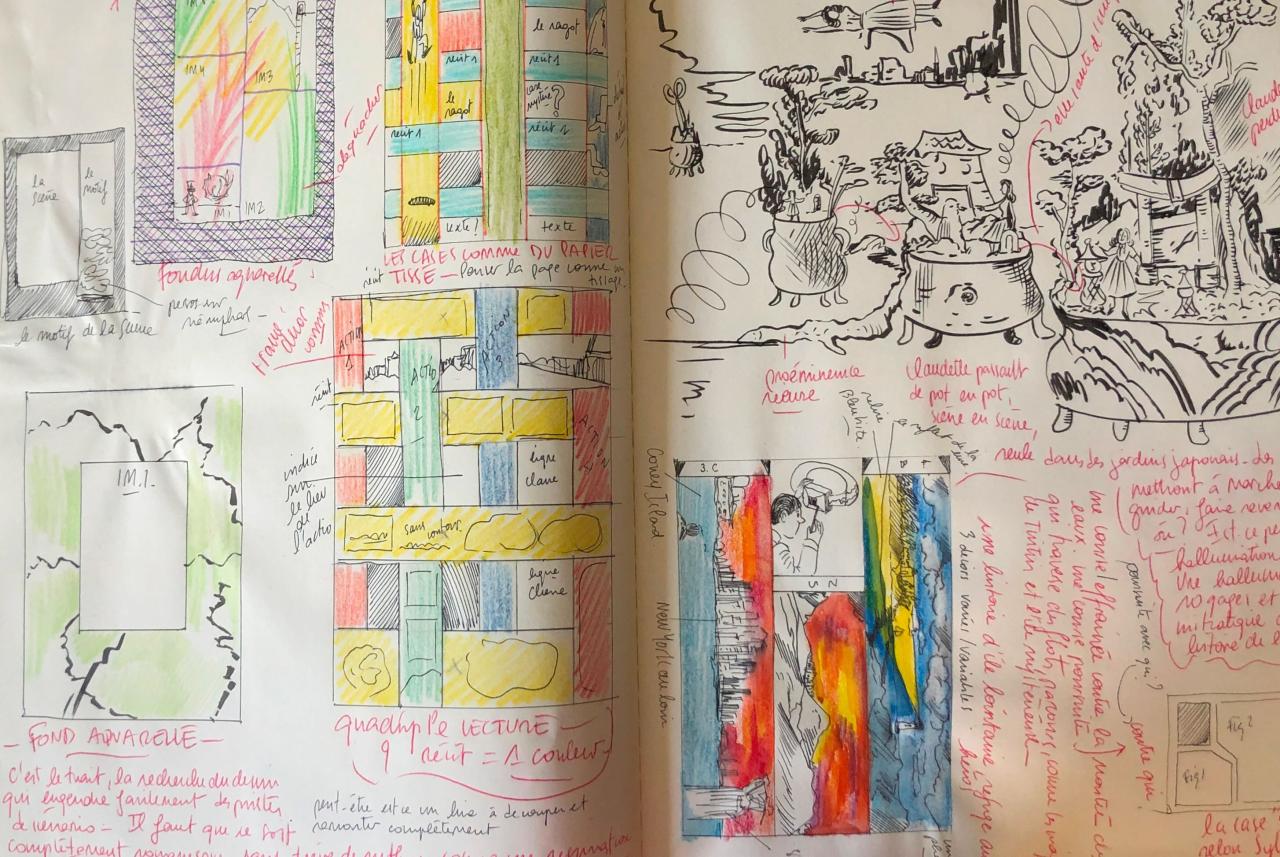
In consulting documents buried in chosen and cherished archives, whether personal or familial, or devoted to strangers8, and in reading any available contemporary material, Camille Lavaud Benito carries out detailed and erudite investigations that liken her work to that of a historian, a researcher or an investigator.9 In these, she discovers hidden life journeys and forgotten and hitherto unseen connections. This research, at once laborious and thrilling, provides her with “multifaceted stories that are constructed simultaneously and echo one another, like communicating vessels.10” They come together as a gallery of characters and life stories linked to specific locations and geographies, depicted in luxuriant notebooks. Her consistently elaborate stories — exofictions — weave together singular underlying strata, embedded in intricate roots. It is this “underground life” which animates her, in all of the various branches of her stories, so much so that she named a film project after it in 201711, as well as her first comic book, published by Requins Marteaux in 2021 (which earned her the Fauve Révélation Prize at the Festival d’Angoulême in 2022). She is currently drawing its follow-up, Les Silencieux, which will be published in September 2026.
In Camille Lavaud Benito’s work, the links between comic books and cinema are very prolific. “When I draw comics, I think of them as films”,12 she explains. She considers the film poster to be the “first step in a ‘synthetic preliminary draft’ of a given subject”. “It becomes the graphic embodiment of intermediality, a symbol of textual genetics linking graphic arts, cinema, and literature.” The artist continues:
“I understand this intermediality as an ‘area of fictionality’, an ‘artistic non-location’; a flowing space in which subjects go back-and-forth and bifurcate. For over a decade now (I started working on the posters in 2013), my concerns have been rooted in a perpetual search for stories of the mundane and for capital H History, in an ‘artistic non-location’ (non-pejorative) that I have carved out for myself, between so-called contemporary drawing and publishing. It is a place in which the production per se consists solely in research.”13
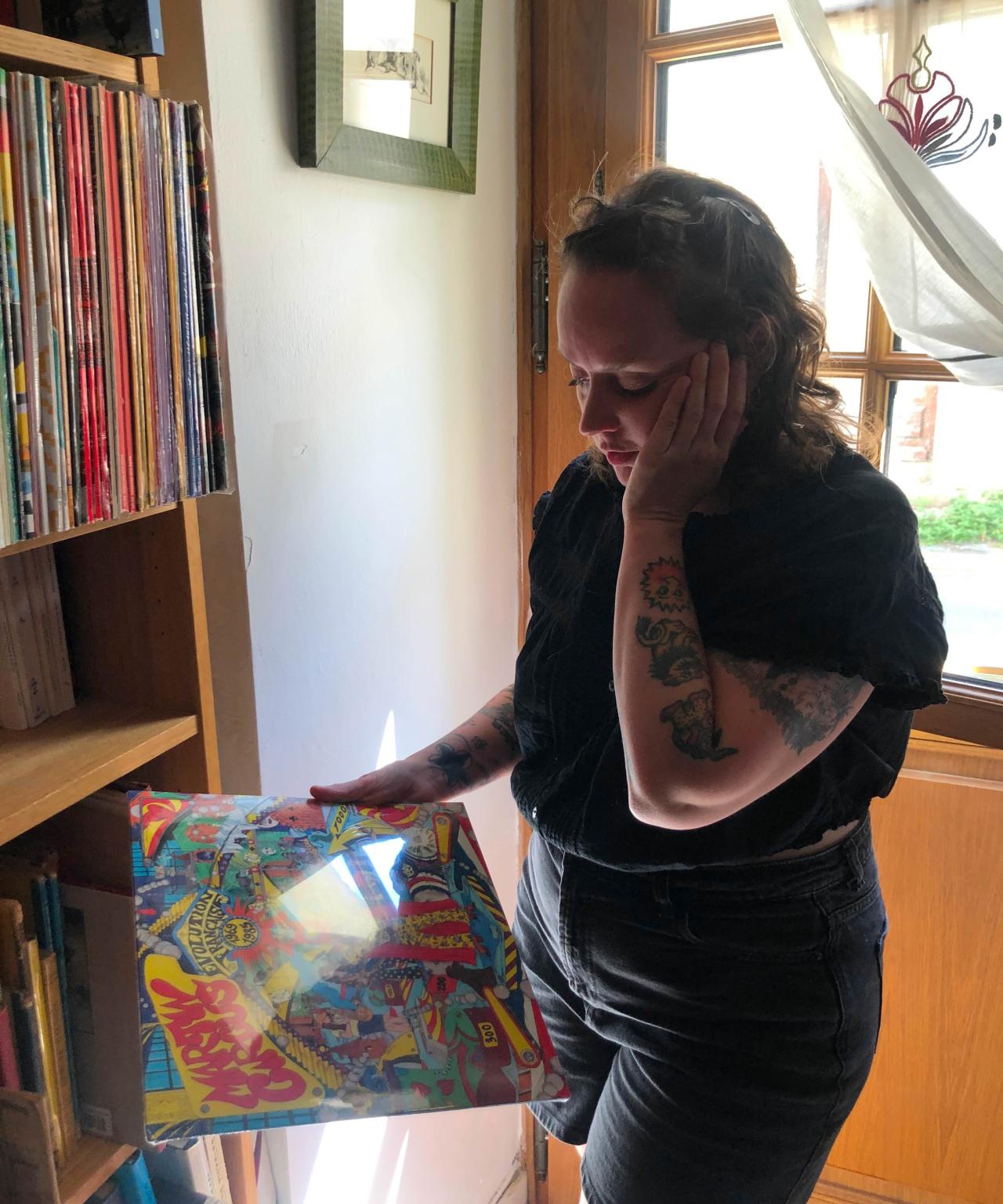
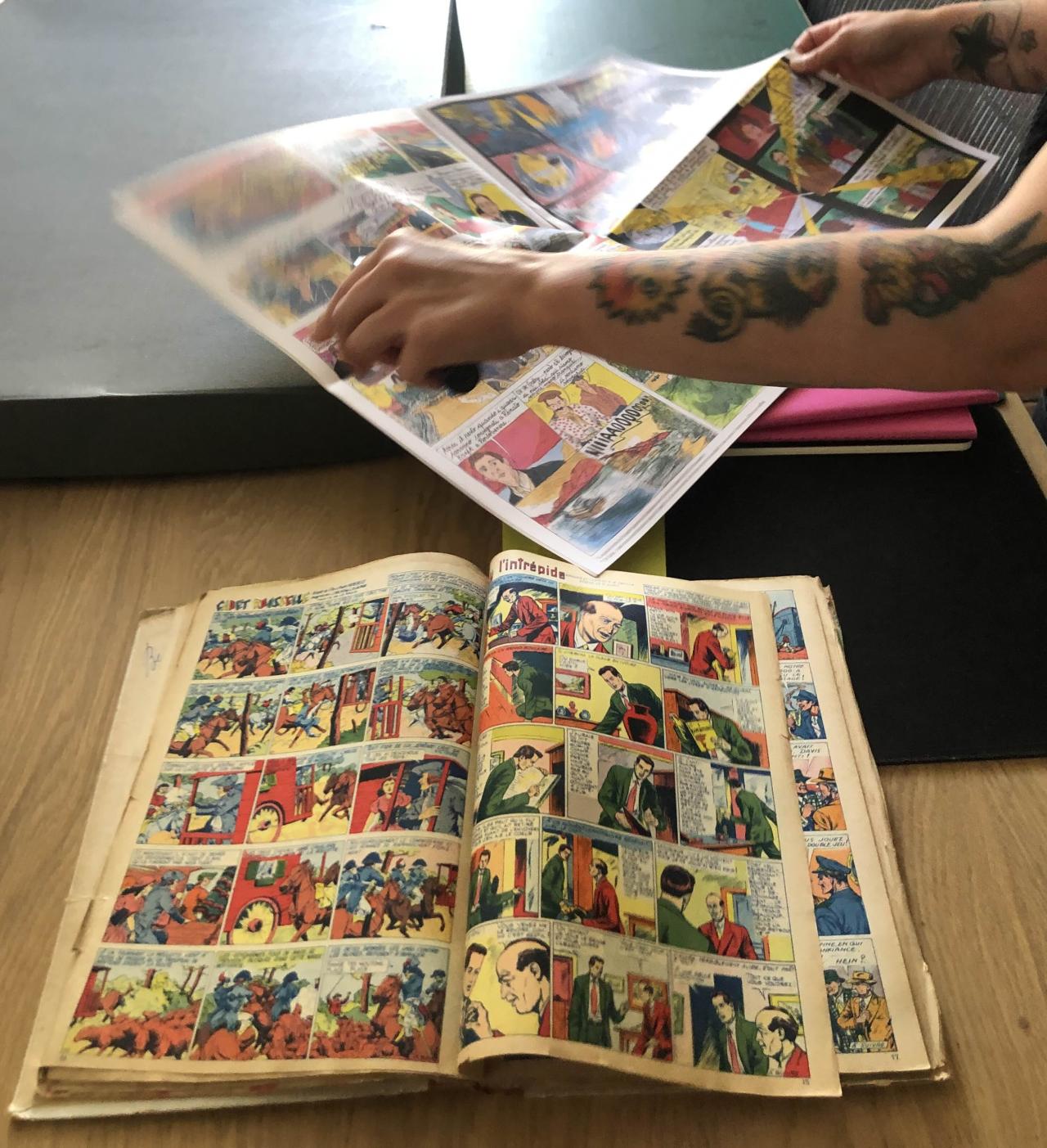
This intermediality is echoed in her impressive visual culture, which constitutes an inexhaustible and constantly broadened source for her plastic production: “a collection of films — sixty or so films that I love the aesthetic of and know by heart — which could be a cinematic score”14, a substantial archive of film reviews, as well as paintings and comic book albums and magazines. All of which the artist scours for samples of motifs, attitudes, and bright and unique colour palettes.
And so Camille Lavaud Benito offers her audience and readers intellectual and sensitive journey into a past world, into another world, and into today’s world. Unrestricted journeys on which one endeavours, keenly and passionately lost, to once again grasp the world and the richness of the thousand and one meanders of its obscure forces.
Notes:
1 To quote Manuel Pomar: “Camille Lavaud moves against the flow, patiently and selflessly constructing a singular body of work.” (“Camille Lavaud, la commune”, Documents d’artistes Nouvelle-Aquitaine, 2020).
2 Conversation with the artist, 4 August 2025.
3 Notes sent by Camille Lavaud Benito in an email, 20 December 2025.
4 Her first series of drawings was titled La mémoire cornée [Dog-eared memory, 2015]. https://dda-nouvelle-aquitaine.org/La-memoire-cornee-51747).
5 The artist chose to add his name to hers recently.
6 “He used to tell me: ‘You must draw Picasso’. He lived in a tiny flat, and as soon as I’d draw something he’d pin it to the wall. There was a huge accumulation of them after a few years. They produced stories within stories.” (Conversation with the artist, 4 August 2025). In recent years, the artist has revisited “the importance of seeing this accumulation of drawings over the years on that wall, which probably impacted [my] practice of drawing, this same accumulation, this obsession with multiple drawings.” (Email, 7 January 2026).
7 Notes sent by Camille Lavaud Benito in an email, 20 December 2025.
8 Notably the Dordogne and Gironde regional archives, as well as the archives of the Cinémathèque and Parisian police department.
9 The artist considers the lengthy “anti-investigation” that former France Inter journalist Cerno (Julien Cernobori) devoted to Jean-Thierry Mathurin and the Thierry Paulin affair to be an excellent example of this type of process.
10 Notes sent via email, 20 December 2025. What the artist also sees in this multiplicity of mirrored stories is an actual “work recipe”, which structures her “narrative play”.
11 And to an actual short film available on the online platform Vimeo
12 Conversation with the artist, 4 August 2025.
13 Note sent by Camille Lavaud Benito in an email, 20 December 2025.
14 Conversation with the artist, 4 August 2025. She elaborates: “When I was working on Le Mystère Cézanne, there’s a scene where a man climbs into a window. I combed through all of those films to find an identical scene.”
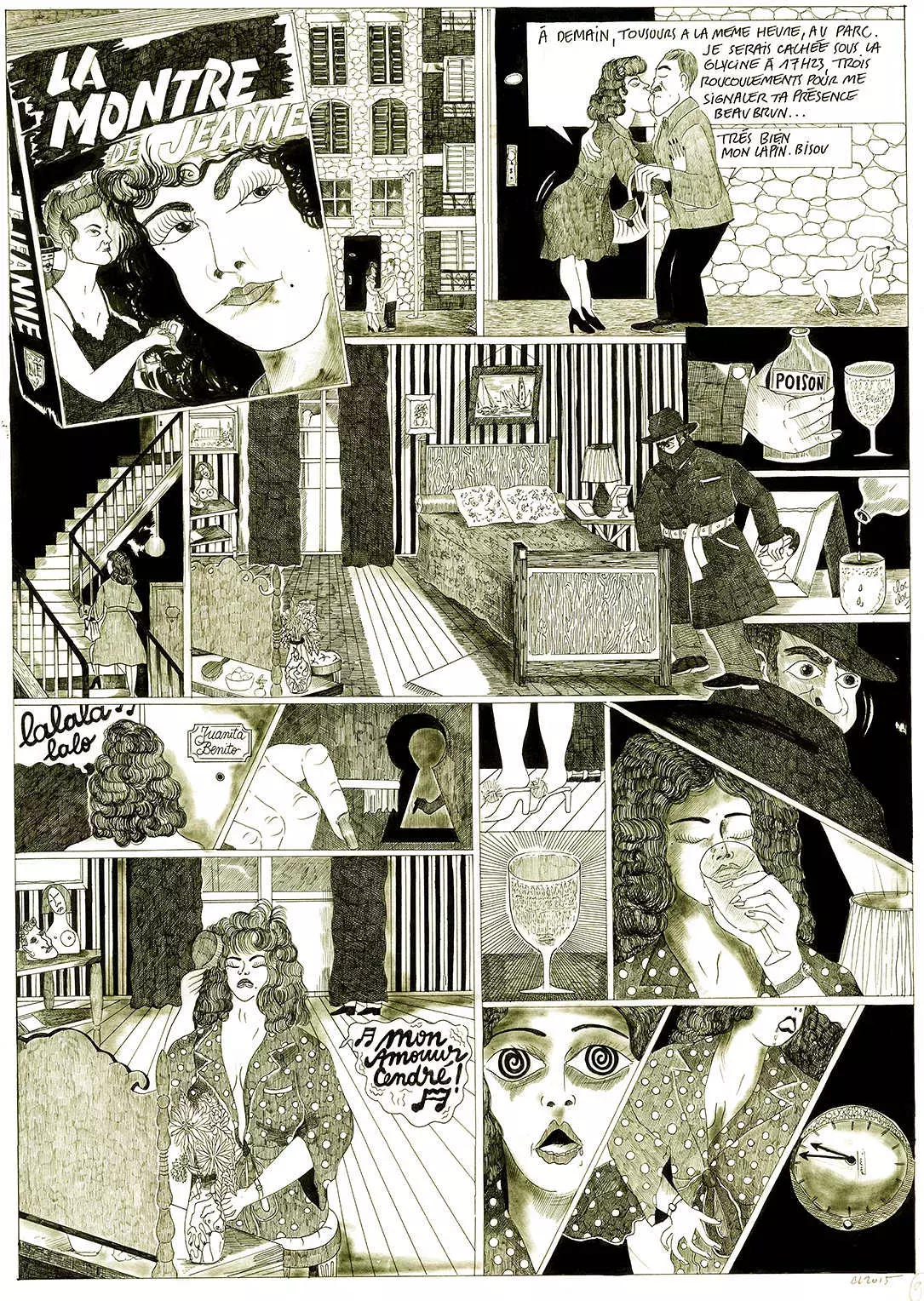
India ink and 0.3 pen on paper, 31.23 x 43 cm
© Camille Lavaud Benito © Adagp, Paris
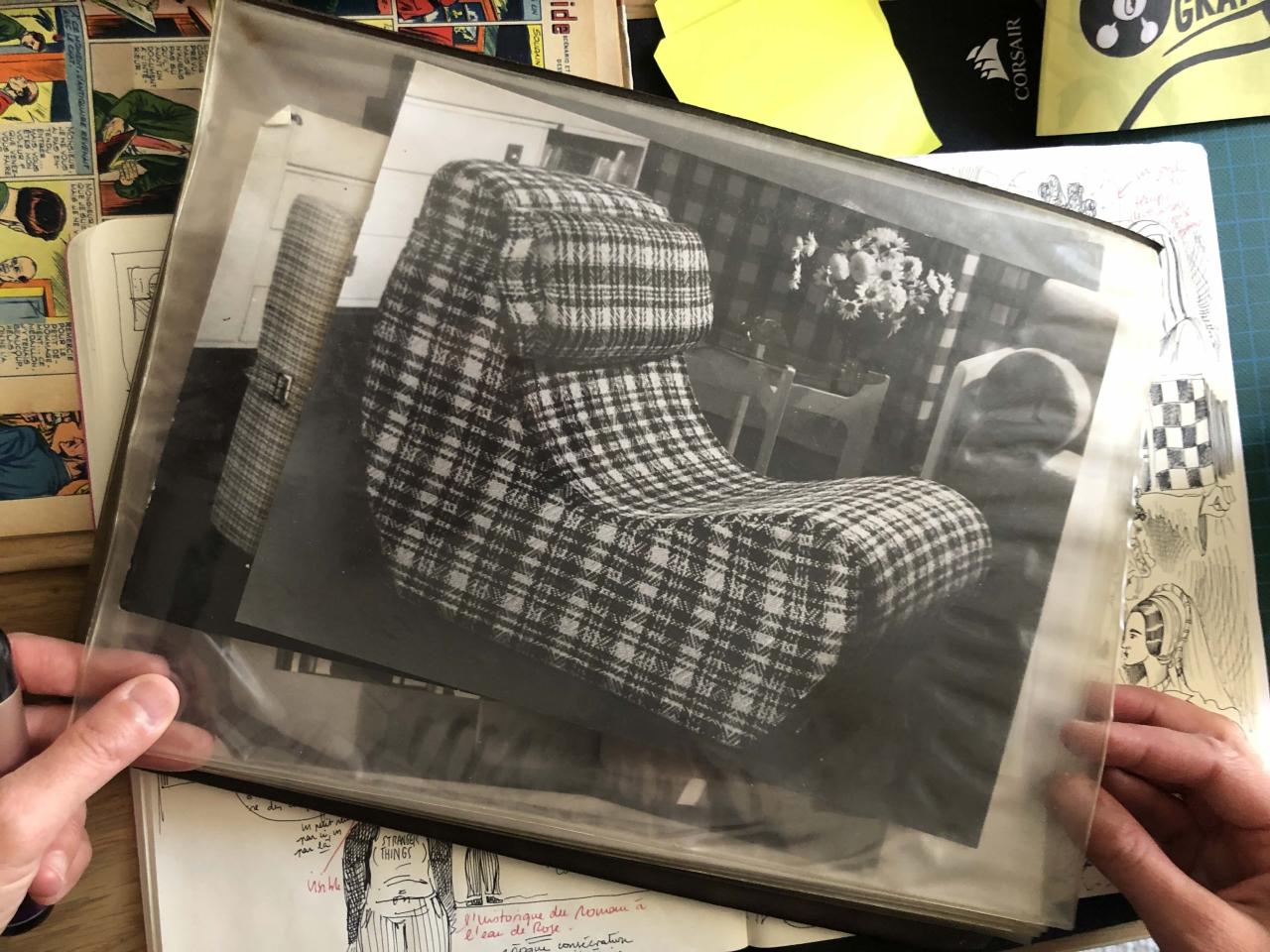
© All rights reserved
© All rights reserved
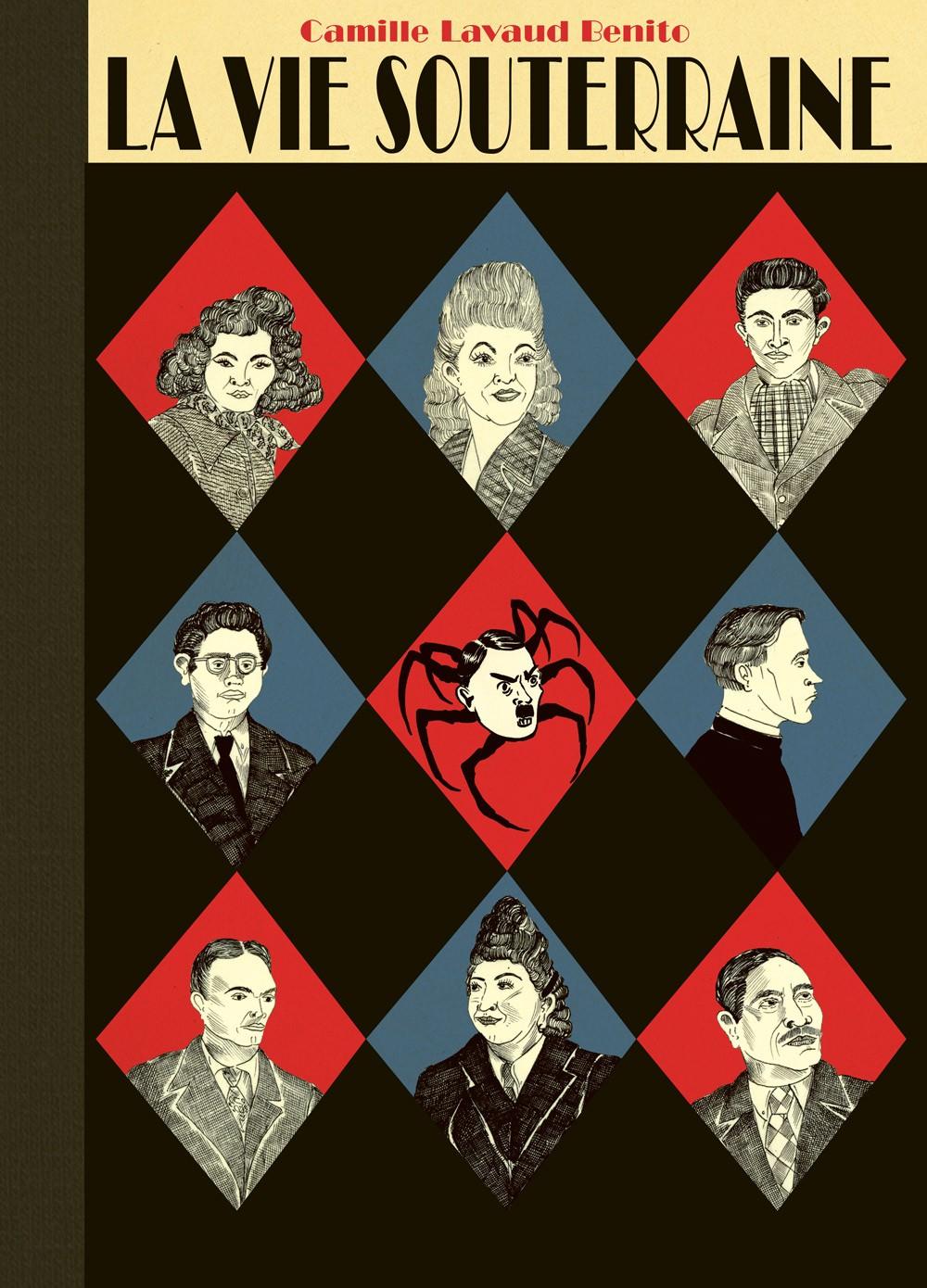
Graphic novel, 23 x 32.5 cm, 96 pages - Éditions Les requins marteaux, Bordeaux
Fauve Révélation (Discovery Award) — Angoulême Festival 2022
© Camille Lavaud Benito © Adagp, Paris
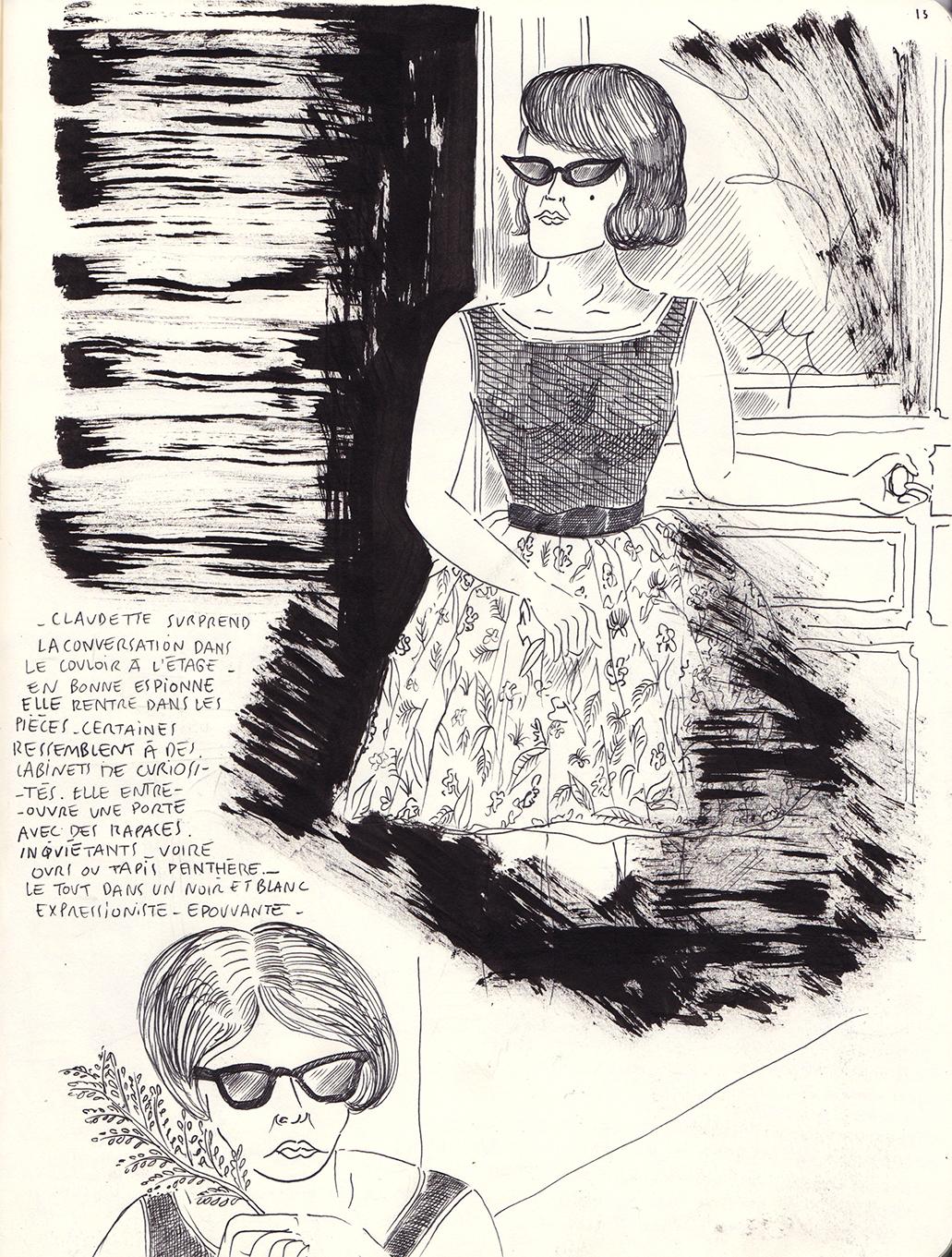
0.3 pen, India ink, ballpoint pen on paper, 19 x 25 cm
© Camille Lavaud Benito © Adagp, Paris
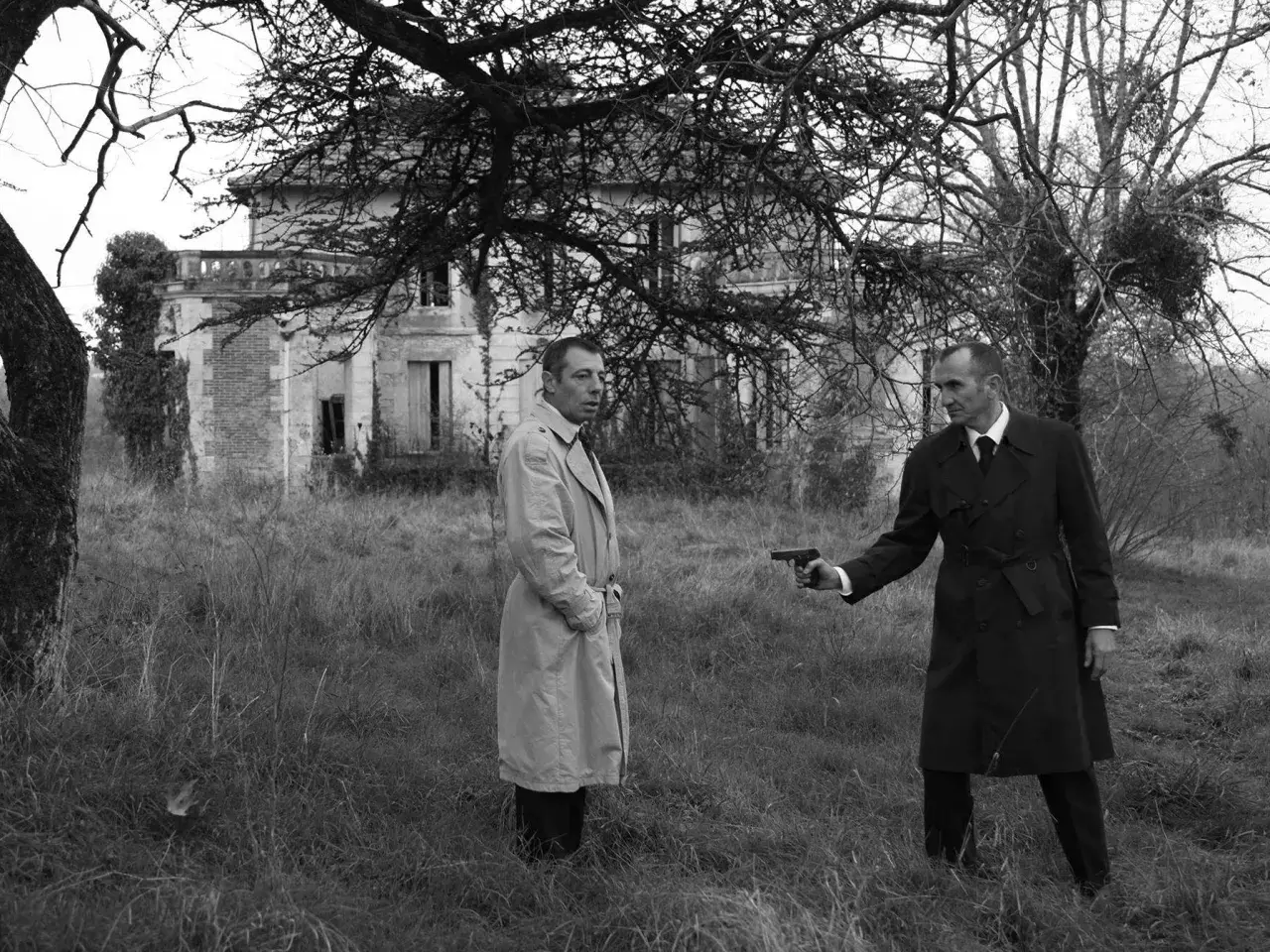
Filming photograph: © Elsa Emilie Martin
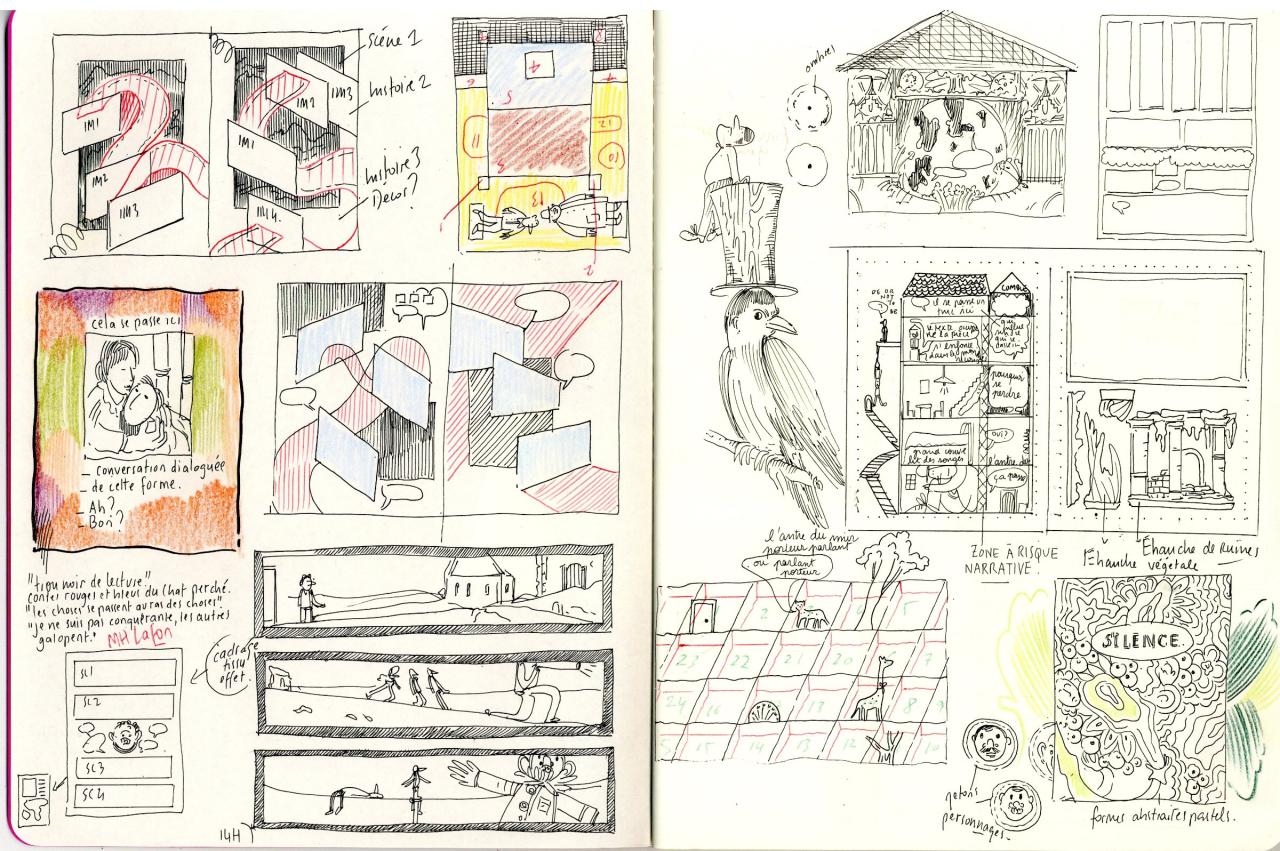
0.3 pen, India ink, ballpoint pen on paper, 19 x 25 cm
Research for a graphic novel project
© Camille Lavaud Benito © Adagp, Paris
© All rights reserved