Max Bondu
Foresight
“Only the present is real, since it is where virtualities are realised, where they randomly crop up. And the present is wherever I am: I am always present. I am the black hole that virtualities rush into in order to realise themselves. Virtualities come up to me: they are my future. […] Isolated elements (molecules, atoms, particles, genes, information bits) combine and recombine by chance. They can form, at random, unlikely situations. Nebulas, living cells, human brains. To program these elements is to prompt such chances.”
Vilém Flusser1
Chance is the reason why the bermuda workshops2, co-founded by Maxime Bondu and constructed on a former brownfield site in Sergy in 2022, are located less than five kilometres from the European Organisation for Nuclear Research Centre (CERN), which stands on the other side of the French-Swiss border, in Geneva. The activities undertaken by the laboratory, which houses the largest and most powerful particle accelerator in the world in the form of a 27-kilometre circumference ring made out of thousands of superconductive magnets and fitted with accelerating devices, have become the subject of endless fears and rumours of science-fictional proportions. What if physicists lost control of the big bad Hadron Collider (LHC) and it ended up generating a giant black hole that sucked in everything in its wake? A theoretically improbable hypothesis that nonetheless reminds us that fantasy is inversely proportional to reason. But even without going this far, one has to admit that strange things are happening “down below” which we are unable to see or, quite frankly, fully comprehend.
Maxime Bondu’s interest in the interpretation of signs and the materialisation of invisible forces or abstract data has recently led him, due to this fortunate vicinity, to take a closer look at the situation from the outside, by filming with a drone from 50 metres above the Pays de Gex countryside (Les incommensurables, les champs verdoyants du Pays de Gex, 2023). The footage, like a sort of digital colour field painting, reveals the impact of atomic activity on the surface, as displayed by the irregular plant growth — a form of aerial archaeology reminiscent of crop circles, the Nazca lines and other patterns that have been observed from the sky for decades, and come with their share of paranormal theories and ufological hypotheses.
The artist combines theoretical research and a specific skillset to bring to life a plurality of forms and techniques that are not aimed at confirming anything, but rather at sounding out the tangibility of the events which he is sensitive to or mindful of, whether it be the mysterious disappearance at sea of physicist Ettore Majorana in March 1938 (The Macedonians Share, 2017); the discovery of debris from the Challenger space shuttle on a Florida beach by a motel’s anonymous guest in 1996, ten years after it exploded after lift-off (Challenger, 2019); the accusation by Russian authorities of American chess player Bobby Fischer, who was suspected of trying to destabilise his opponent during the 1972 world championship in Reykjavik (The Remote Viewer, 2015); or Garry Kasparov’s bug-induced defeat by IBM’s supercomputer Deep Blue, etc.
Subtle blends of science and fiction, geopolitics and cosmology, programming and mistakes: more than simple events, the artist sees in them signs that stand out from the media stream in that they evade any univocal version, any established truth, and remain open to the poetry of doubt and of speculative fantasy.
Language(s) and storytelling are common threads in Maxime Bondu’s work, interwoven with the dialectics of broadcasting/addressing and receiving/interpreting, bound together in the act of transmitting. In the film The Call (2022), which he directed with Simon Ripoll-Hurier, Krishna May, a member of the Language Creation Society, recites a list of 3,926 phonemes made out of 150 characters from the International Phonetic Alphabet.3 Broadcast from a Swiss amateur radio station, the sound signal was directed towards the Moon and received in return by a number of radio antennae on Earth, one of which was set up on the slopes of the Jura mountains.
Like an extension of what soundwaves and language weave into space and time, the ongoing project Uebh, which uses the linguistic and semantic link between the Anglo-Saxon terms weave and wave transcribed from their proto Indo-European root as a starting point, aspires to create weavings based on spectrograms derived from the recording of low-frequency waves produced by ambient electromagnetic activity: or when natural phenomena (northern lights, solar flares, storms…) become not only images, but shapes that bear witness to cosmic events and political and climate issues to come — and currently unfolding.
This vast and complex network of lines, signs and realities, in which (counter-)information, (tele)communication and (retro-)projection intertwine, is what fuels the artist’s practice, guided by intuition as a tool for knowledge and a vehicle for anticipation.
During our meeting in Sergy in preparation for this article, and while we were discussing our respective vision disorders, Maxime tells me that he wears rigid contact lenses at night, which he then removes in the daytime to see clearly. Apparently, the corrective device informs his cornea while he sleeps… I have worn soft lenses (during the day) for thirty years and have never heard of such a thing! I cannot help but to see this as an image of anticipatory clear-sightedness and — hopefully — an auspicious sign.
Notes:
1 Flusser Vilém, “Reconsidérer le temps”, Multitudes, 2019/1, no. 74, p. 207-211. DOI: 10.3917/mult.074.0207.
URL: https://shs.cairn.info/revue-multitudes-2019-1-page-207?lang=fr
2 “bermuda is a project of artists' studios founded by Max Bondu, Mathilde Chénin, Julien Griffit, Bénédicte Le Pimpec and Guillaume Robert. The building, designed by the architectural firm ACTM, was self-built by the team. The project is based on a collaborative model. Born of the need to perpetuate creative spaces in the Lake Geneva region, bermuda is developing a singular project, which articulates research, production and distribution in the arts. Its artistic project is based on residencies, companionships and workshops. Each of the proposals is thought out endogenously, based on the issues at stake for the place and the team at the time they are formulated.” Presentation taken from the website https://www.bermuda-ateliers.com
3 The International Phonetic Alphabet (IPA) is a universalist phonetic notation system created in 1888 by British and French linguists. The artist was particularly inspired by Arthur C. Clarke’s short story The Nine Billion Names of God, published in 1953, in which Tibetan monks strive to find the “true name of God” by collaborating with IBM engineers to find all the possible combinations their alphabet would provide, each sequence having no more than nine characters.
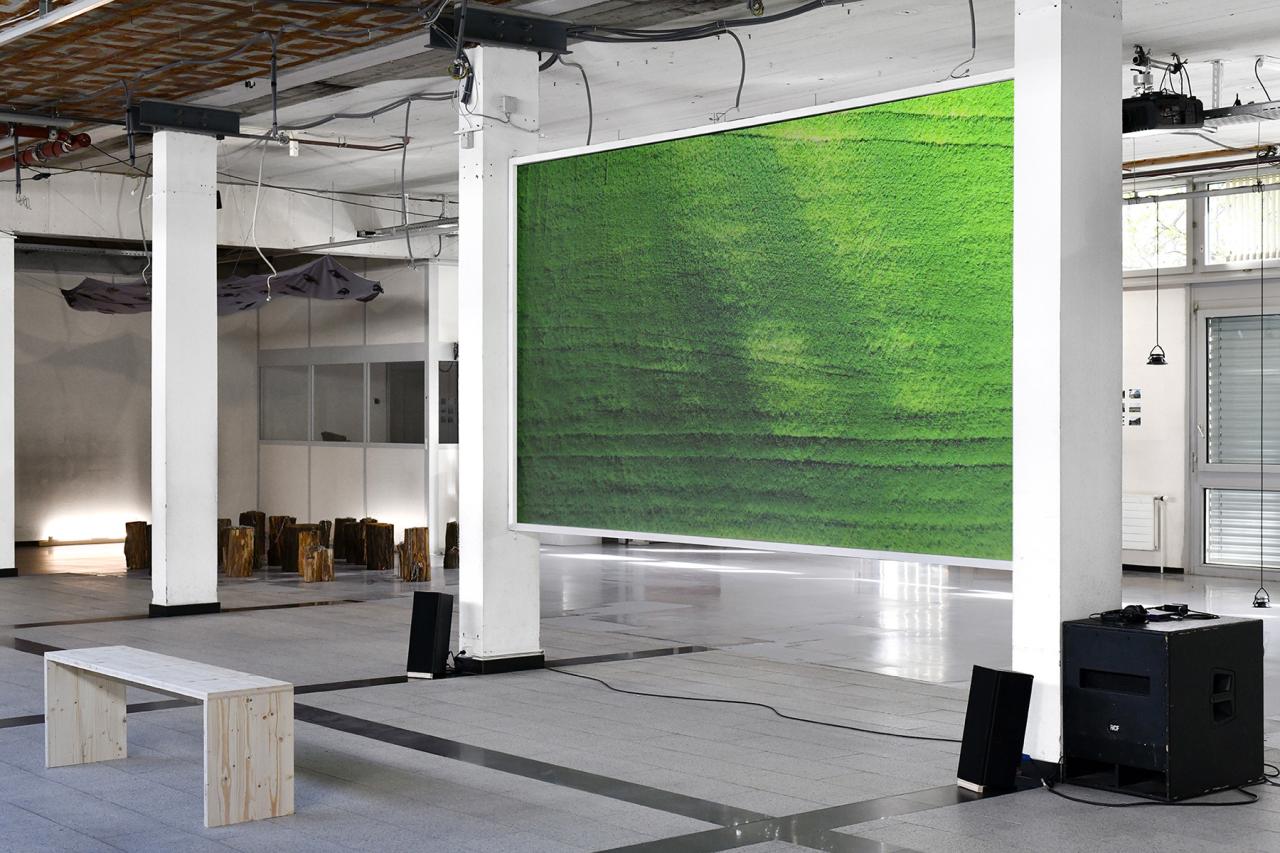
View of the exhibition Matza Edgelands – Under the Radar, Ancienne poste des Charmilles, Geneva, 2022
Photo: © Matza
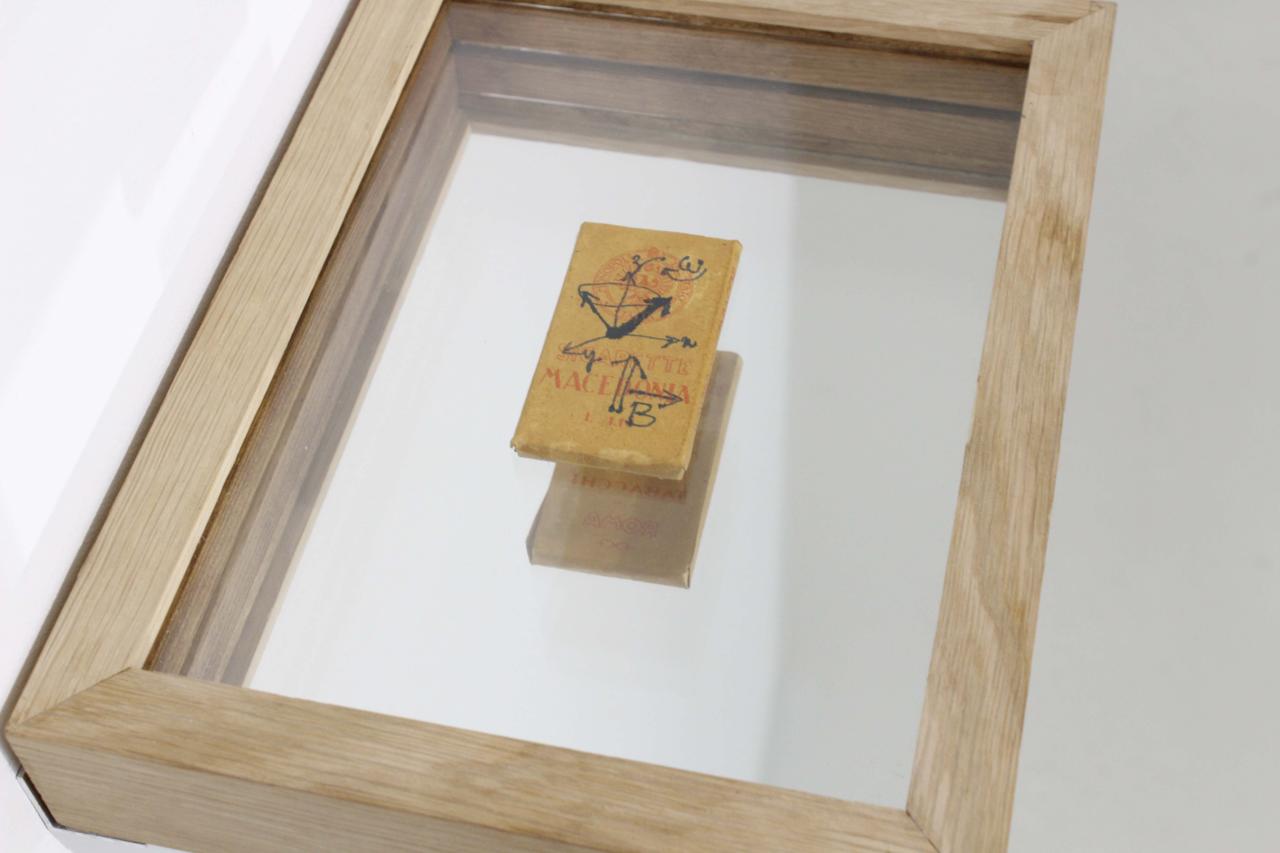
View of the exhibition Information quantique (Quantum Information), Galerie Jérôme Poggi, Paris, 2017
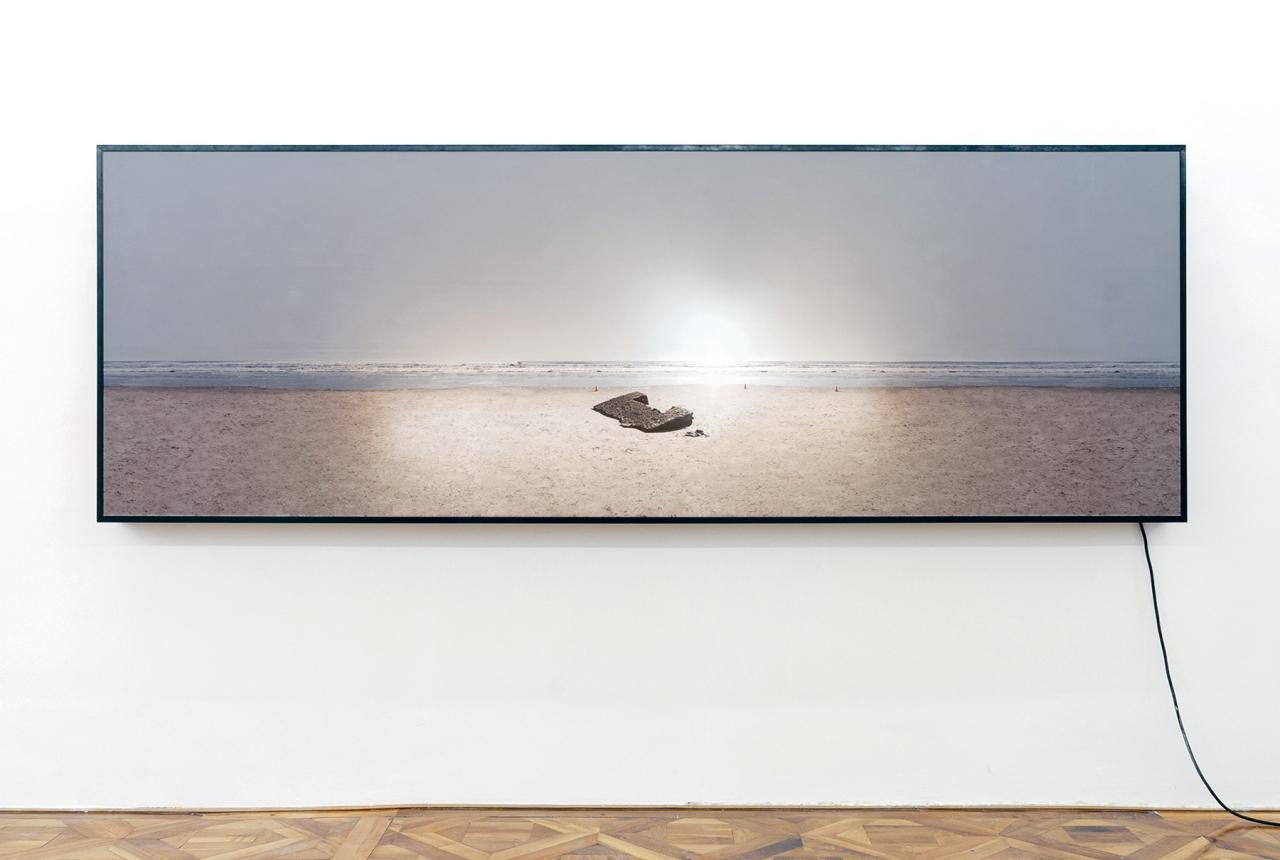
View of the exhibition Données insuffisantes pour réponse significative (Insufficient Data for a Meaningful Answer), La Villa du Parc, Annemasse, 2012
Photo: © Emile Ouroumov
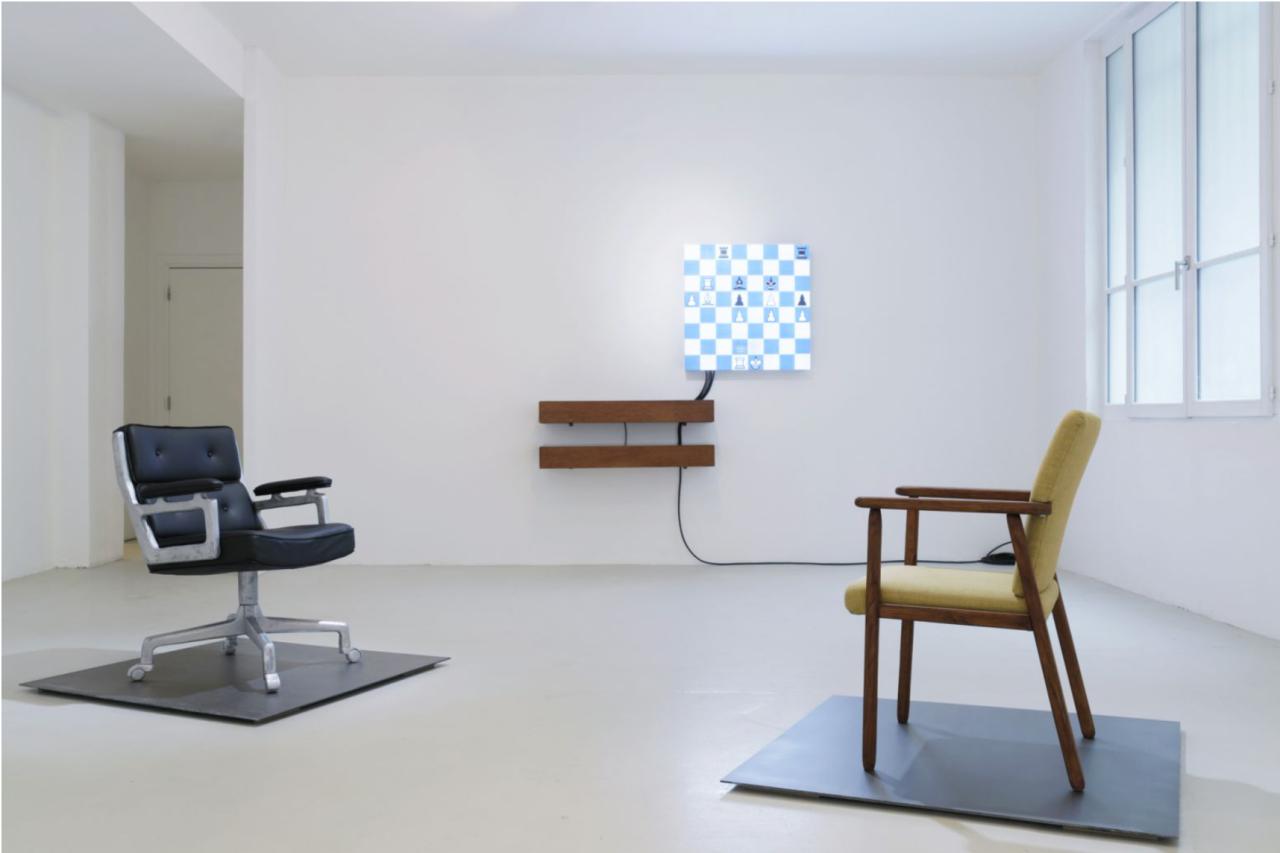
View of the exhibition The Remote and the Deep War, Galerie Jérôme Poggi, Paris, 2015
Photo: © Nicolas Brasseur
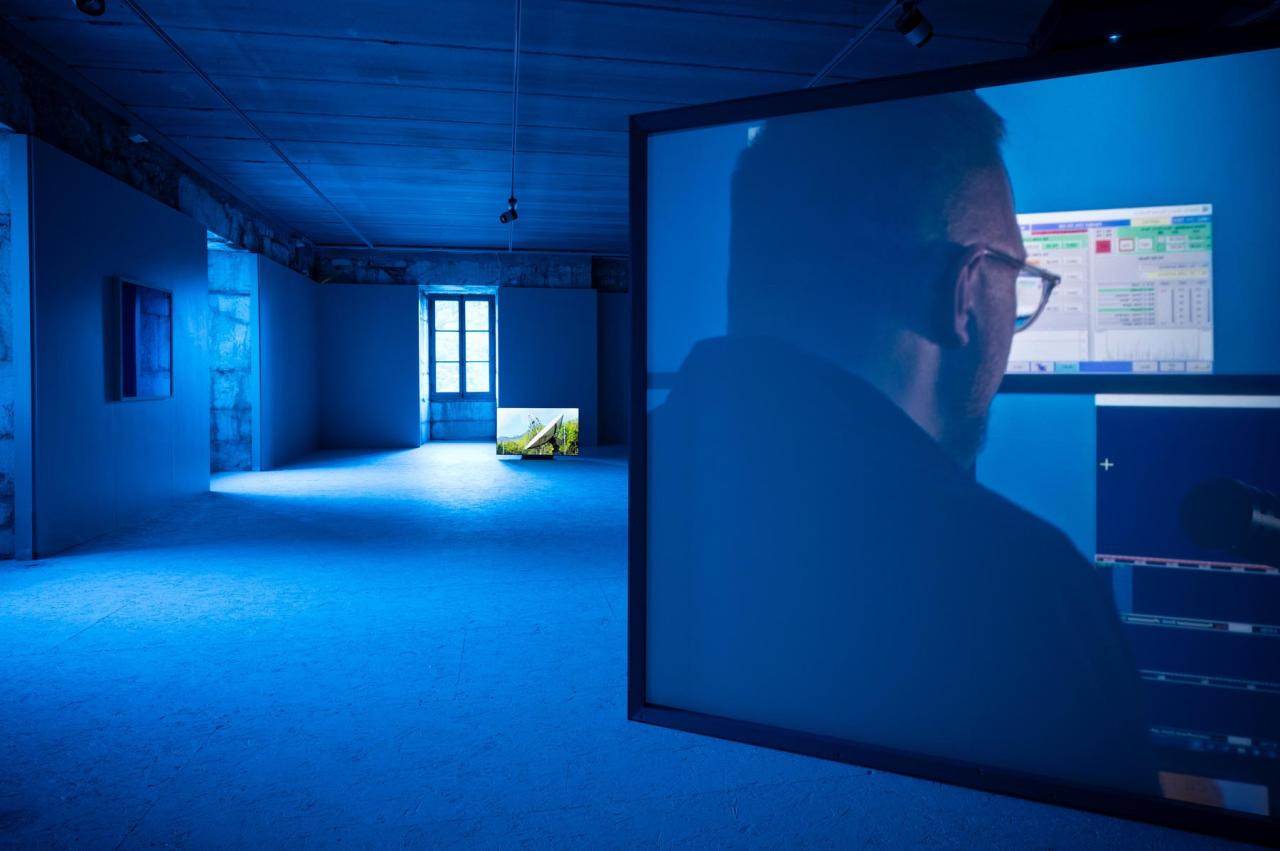
Video, 177' (loop); Video, 13' (loop)
View of the exhibition Une Clameur, Fort l'Écluse, Léaz, 2024
Photo: © Guillaume Robert